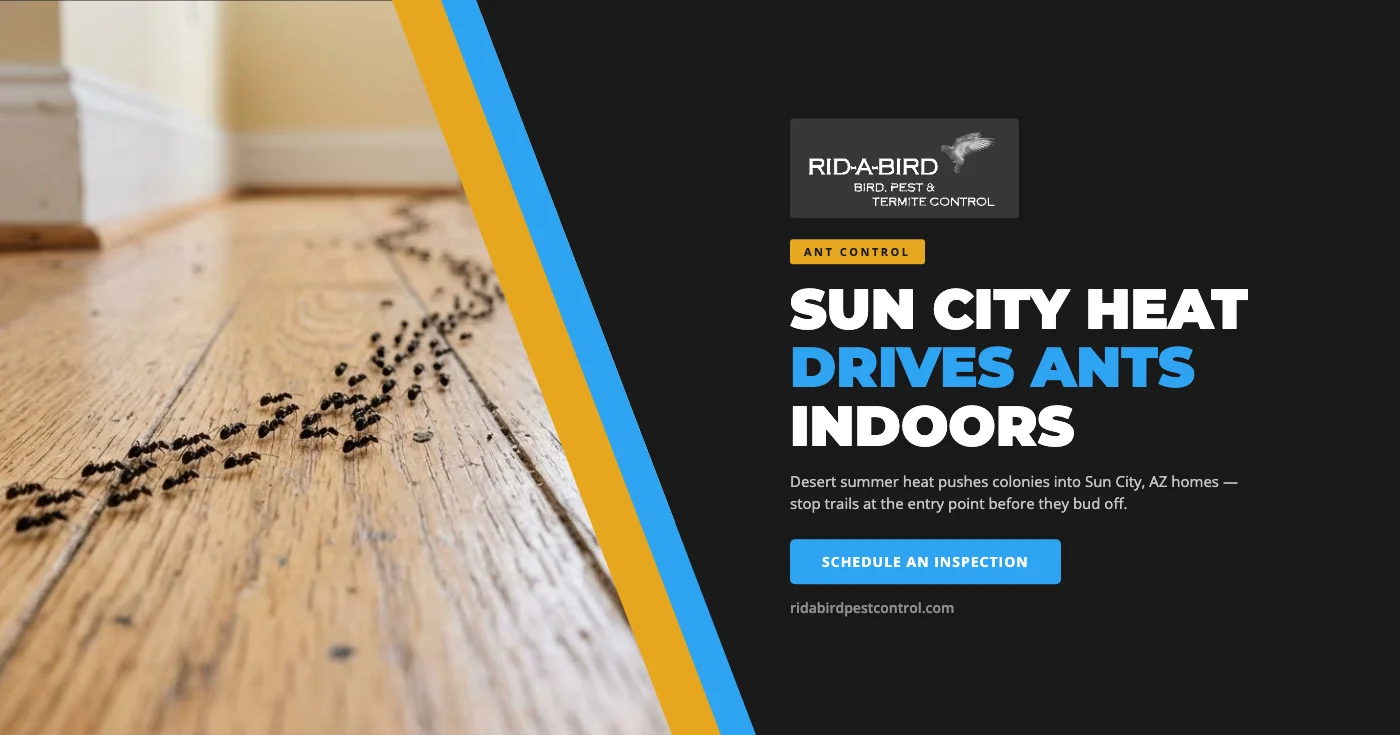
Once the Sun City, AZ thermometer holds above 105 degrees and overnight lows stop dropping below 80, the ant colonies that have been quietly working under driveways, block walls, and irrigated landscaping all spring start hunting for water — and the moisture trail almost always leads inside your home. By mid-June, most Sun City homeowners notice the first thin line of ants on a kitchen counter, in a pet food bowl, or along a bathroom baseboard. By July, those one-off sightings turn into multi-day trails that come back the day after every clean. If you are wiping the same counter twice a day, schedule ant control in Sun City, AZ before monsoon season pushes the next wave indoors.
At Rid-a-bird Pest Control, we have treated ant problems across Sun City and the West Valley since 1991. This guide covers why ant pressure spikes from late May through September, which species you will find around a Sun City home, where they enter, why retail sprays usually make the problem worse, and how we eliminate a colony at the source instead of chasing surface trails.
Why Sun City Summers Drive Ant Colonies Indoors
Ants are cold-blooded and water-driven. Their foraging range, brood production, and trail intensity all track outdoor temperature and humidity, which is exactly why Sun City summers are the worst stretch of the year. Daytime highs hold above 105 from June through September, overnight lows climb into the mid-80s, and natural ground moisture disappears almost entirely. The colony does not pack up and leave the yard — it sends scouts looking for the only reliable water source within range, and that source is the slab leak, the sink trap, the pet bowl, the condensate line, or the irrigated patch of lawn right against your foundation.
The second driver is brood pressure. Most desert ant species peak reproductive output in late spring, so every colony is suddenly feeding thousands more larvae than it was in April — more mouths means more foragers, longer trails, and a lower threshold for what counts as worth invading. The first monsoon storms in July make it worse: flooded soil pushes underground nests up and out, and colonies that were content under a sidewalk start showing up at the garage threshold.
According to the University of Arizona Cooperative Extension's Community Integrated Pest Management program, the most effective response to a summer ant push is a combination of habitat modification, exclusion, and targeted baiting — not broadcast spraying. That distinction is why one of the most common moves homeowners make is the one that makes the problem worse.
Common Ant Species Found in Phoenix-Area Yards
Five species do almost all of the work in Sun City homes. Knowing which one is on your counter changes both the urgency and the treatment plan, so our technicians always identify the species before we propose a program.
- Pavement ants — tiny, dark brown to nearly black, and the species most Sun City homeowners see first. They nest under sidewalks, driveways, slab edges, and pool decking, and they are the classic kitchen counter trail ant. Not medically dangerous, but they recruit fast and rebuild quickly after a surface kill.
- Odorous house ants — small, dark, and named for the rancid coconut smell they release when crushed. They nest in wall voids, behind dishwashers, under sinks, and anywhere with steady moisture. Once they find an indoor water source they build satellite nests, which is why they are the hardest species to clear with a contact spray.
- Argentine ants — light to dark brown, an invasive species that forms supercolonies stretching across entire blocks. In Sun City they thrive in irrigated lawns and HOA landscaping. A retail product knocks down one trail and leaves the rest of the network untouched.
- Carpenter ants — the largest ants you will see in Arizona, a quarter-inch to half-inch long, usually black or reddish-brown. They excavate galleries inside wood for nesting and target irrigated wood landscape features, roof eaves, and palm trees — often a sign of moisture damage you cannot see.
- Native and imported fire ants — reddish-brown, aggressive, and far more common in West Valley landscaping than most homeowners realize. The University of Arizona Community IPM program notes that imported fire ant stings commonly cause fluid-filled blisters and that roughly 1% of children and 3% of adults have allergic reactions to Hymenoptera venom that can be life-threatening. Mounds show up in open, sunny soil along walkways, irrigation lines, and turf edges.
If you see a small dark ant on a kitchen counter, treat it as pavement or odorous house ant until we identify it. If you see a reddish mound with aggressive ants pouring out when disturbed, do not poke it — call us before anyone steps in it.
How Desert Heat and Drought Push Ants Into Your Home
Three forces collide every Sun City summer. The first is heat — soil temperatures above 100 degrees push foraging from midday to dawn and dusk, which is why you often see the first trail at 6 a.m. when you walk into the kitchen for coffee. The second is drought: from mid-May through the first monsoon storm, the only consistent water within range is the moisture inside or right against your home. The third is food density — Sun City pantries, pet bowls, soda spills inside trash cans, and outdoor BBQ patios concentrate the carbohydrates and proteins a brood-pressured colony needs.
That combination is why a yard with zero indoor activity in February produces a multi-room trail in July. The colony is not bigger because of anything you did — it is bigger because Arizona summer is when it grows fastest, and your home is closer to water than the desert is.
Where Ants Enter Sun City Homes and What Attracts Them
Ants need three things to commit to an interior trail: a way in, a destination, and a return path. When we run an ant inspection, these are the points we check first:
- The gap under the kitchen sink where supply lines and drain pass through the cabinet floor
- The slab joint at the base of every exterior wall, especially the kitchen and laundry-room sides
- Weep holes and weep screeds at the bottom of stucco walls
- The garage door threshold, especially where the side seal meets the bottom seal
- Window frames and sliding-door tracks on the shaded side of the house
- The condensate drain line where it exits near the HVAC unit
- Exterior plumbing penetrations behind the dishwasher, ice maker, and water heater
The attractants that turn a one-time scout into an established trail are predictable: pet food bowls left full overnight, sticky residue on the kitchen island and trash can lid, the bowl of fruit on the counter, the recycling bin with soda cans inside, and any plumbing leak quietly feeding moisture into a wall void. Cut the attractants and the trail loses its return value, but that alone almost never clears an established colony — the foragers simply look harder.
Why Store-Bought Sprays Often Make Ant Problems Worse
The reflex move when you see a kitchen counter trail is to grab a can of ant spray and wipe the line out. We understand it, but it is almost always the move that turns a small problem into a long one.
A visible ant trail is the foraging surface of a much larger colony. The workers you see are a fraction of one percent of the total population, following a pheromone path back to a queen and a brood chamber you cannot see — usually outside, under the slab, or inside a wall void. When you spray the trail, you kill the foragers on the counter and scatter the pheromone path. The colony interprets that as an attack and does the one thing it is best at: it splits. Many indoor-nesting species, especially odorous house ants, respond to chemical pressure by budding off satellite nests. What was one trail in one room becomes three trails in three rooms within a week.
Repellent sprays make it worse a second way — they keep foragers from carrying anything back to the queen, which is the only path to actually killing the colony. The U.S. Environmental Protection Agency's guidance on managing ants recommends slow-acting bait products that workers carry back to the nest, combined with exclusion and habitat modification, instead of contact sprays on visible trails. That is the same approach the University of Arizona Cooperative Extension recommends, and it is what our team uses on every Sun City service call.
How Rid-a-bird Pest Control Eliminates Ant Colonies for Good
Our Sun City ant control service starts with a full interior and exterior inspection. We identify the species, map every active trail back to its entry point, locate the harborage where we can — under slab edges, in block wall cavities, inside irrigated landscape features — and document the moisture and food conditions feeding the population. From there, the treatment plan depends on what we found.
For surface-nesting species like pavement ants and Argentine ants, we apply non-repellent residual products to the exterior perimeter, slab joints, weep screeds, and the foraging zones we mapped. Workers do not detect the product, so they walk through it, carry it back on their bodies, and transfer it through trophallaxis — the food-sharing behavior every colony depends on. The queen and brood are reached within days, and the colony collapses from the inside.
For interior-nesting species like odorous house ants, we add targeted baits placed on the active trail and inside void access points so workers prioritize the bait over their normal food source. We pair that with exclusion at the entry points we identified and walk the homeowner through the moisture and food conditions that created the problem.
Quarterly service afterward keeps exterior pressure down through every monsoon and summer cycle. We have been doing this work in the Phoenix metro since 1991, and every program comes with a follow-up window if activity returns between visits. For broader pest pressure — scorpions, spiders, roaches, crickets, and the rest of the Valley's summer lineup — our general pest control program covers the same perimeter.
Frequently Asked Questions About Ant Control in Sun City, AZ
When does ant season start in Sun City, AZ? Surface activity climbs as soon as overnight lows stop dropping below 65 degrees, usually in mid-April. The serious push indoors begins once daytime highs hold above 100 in late May, and peak indoor activity runs from mid-June through September. The first monsoon storms in July trigger a second wave as flooded soil drives ground-nesting colonies up and out.
I keep my house spotless. Why do I still have ants? Cleanliness lowers attractant pressure but does not address the colony. A pristine kitchen with a slab joint open to the exterior and a sink trap producing condensation is still attractive to a brood-pressured summer colony — the water source alone is enough. Lasting control requires species identification, exclusion at the entry point, and a colony-level treatment.
Are the products you use okay around pets and kids? Our technicians use targeted, lower-impact products applied in cracks, voids, and perimeter zones — not broadcast indoor sprays on living surfaces. We walk every household through a re-entry window before service begins and adjust the plan for homes with pets, kids, or chemical sensitivities.
How long until the trails stop after my first treatment? Most Sun City homeowners see existing trails go quiet within 3 to 7 days of the first service, and full colony collapse runs 10 to 21 days for surface-nesting species. Indoor-nesting odorous house ant populations may take two visits across three to four weeks because of satellite nesting.
Do you service Sun City West, Surprise, and the rest of the West Valley too? Yes. Our ant control service covers Sun City, Sun City West, Surprise, Peoria, Glendale, and most of the Phoenix metro. To schedule an inspection, visit our ant control page.